Los puntos cuánticos (qdots o quantum dots en inglés) o átomos artificiales son nanoestructuras creadas en el laboratorio que miden millonésimas de milímetro —nanómetros—. Inventadas hace casi dos décadas, tienen un sinfín de aplicaciones en áreas tan variadas como las telecomunicaciones, la computación cuántica, la seguridad o la biomedicina.
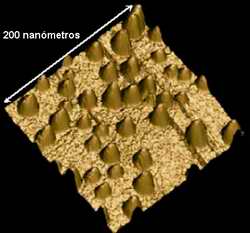
En el mundo macroscópico, los puntos cuánticos pueden tener el aspecto de una simple flat bar, or be dissolved in a liquid. No one would suspect that the substance has been built in the laboratory starting from a few atoms, using techniques that manipulate matter at the nanometer scale. At these dimensions, the material becomes a matrix on which they have grown structures, such as pyramids or mountains, formed by a few hundreds or thousands of atoms. These structures are quantum dots.
special thing is that in them, the electrons are forced to remain trapped, confined in three dimensions, and that creates curious quantum phenomena. In particular, the electrons are arranged in a single point as atom, hence the nickname artificial atoms. And hence, too, that the structured field in quantum dots have properties that can be controlled at will.
One is that, when illuminated, QDs re-emit light at a wavelength very specific and depends on the size of the quantum dot. The smaller the dots, the smaller the wavelength and more pronounced the quantum properties of light they emit. The result is that "you can design in advance a quantum dot to the desired wavelength," said Charles Weaver, Department of Theoretical Physics of Condensed Matter Autonomous University of Madrid (UAM).
This property that the laboratories are willing to take since the early nineties, "but only now has the manufacturing technology has reached a level of acceptable quality for commercial applications," says Weaver. "Now, the field is booming." Fernando Briones, National Microelectronics Centre (CNM), CSIC, corroborates: "Yes, lately there is already a diverse fauna of quantum dots. They are of many types, for very different."
A report this year the company's Business Communications Company claimed that by 2009, the market quantum dots overall, counting all applications, would exceed 500 million dollars (about 400.64 million euros). There is an obvious application: optoelectronics. With quantum dots of semiconductor materials as indium arsenide, indium phosphide, are manufactured light-emitting diode lasers more efficient than those used today in CD players, barcode and more. So it is expected to eventually replace the short to medium term.
But also open many more possibilities: photovoltaic cells, telecommunications, security-in notes or documents, in which embed quantum dots invisible to the naked eye in quantum cryptography, or quantum computing , in which quantum dots provide information units, the qubits, the quantum computer is still hypothetical massive computing power. Last year, two groups were able to show whether it is possible to create a quantum link-a-entanglement between two quantum dots, so what happens to one affects the other and vice versa, a basic principle of quantum computers.
research with quantum dots in the UAM and the CNM aims to use as material components for quantum information. Groups Luisa González, Jorge Garcia and Fernando Briones in the CNM and manufacture high performance laser diodes are integrated in semiconductor quantum dots with self-assembly techniques for molecular beam epitaxy .
However, applications that appear to be ahead in terms of marketing are those of biomedicine. In this case, quantum dots are not embedded in a matrix, but are independent crystals, but its substance and its physical properties are the same. Xavier Michelet, University of California, co-authored review of applications of quantum dots in biology published in Science , e-mail explains: "Quantum dots emit bright light and very stable. they yield high contrast images using less powerful lasers, and there are fears that are off. " Moreover, as specific wavelength to avoid overlapping glow, allowing dye while many more structures than with traditional staining methods.
The first use of quantum dots in biology was in a frog embryo, three years ago. Investigators wrapped quantum dots-molecules in micelles areas that are water-soluble so that they can dip in a wet environment, and inject billions of them in frog embryos, then with live imaging techniques were able to follow fluorescent cells and their descendants as they were differentiating for several days. In 2003, another group obtained images of the capillaries of a live mouse that he had injected the quantum dots under the skin. The images had a thousand times higher resolution than those obtained with conventional techniques, to the point that it detected the vibration of the hair to the rhythm of the heartbeat.
But in addition to the quantum dots, that are more or less the size of the protein , they can stick antibodies capable of recognizing compounds, cells or viruses. Many researchers plan to use them as markers of cancer cells, which could follow as they multiply and migrate. Several groups have made and to adhere to proteins that float in the membrane of the cell-receptors. For example, last year a group used them to pinpoint the location of lymph nodes during the operation itself to eliminate, in pigs and mice. And in April this year, reported the use of quantum dots to detect respiratory syncytial virus barely an hour after infecting cells. They have also been used in plants, attached to a protein which in turn is attached to the pollen.
Could we also use quantum dots as carriers of drugs to specific cells, for example? Michelet responds: "The idea of \u200b\u200bnanobots patrolling the blood is seductive (or scary, depending on the point of view), but still falls short of current state of the art in nanotechnology. However, it has long been thinking of a molecular probe multimodal quantum dots themselves can be equipped with additional functions. We are already doing so, putting in each quantum dot a few peptides with solubility properties, some to prevent the quantum dot to adhere to other tissues, some to reach the desired goal ... The list of possible additions to the quantum dot is endless, and they could add molecules with therapeutic action.
Another possibility to which biologists are rubbing their hands is to use quantum dots as molecular probes to penetrate into the Cell. It would be an entirely new field. The staining of cells in vivo and methods are very good and, therefore, quantum dots are an improvement or a method complementary, but never before has aspired to "make a few proteins, each with its quantum dot, and observe under a microscope while performing their tasks in the cell," says Michelet. "It would be like having a miniature camera inside the cell, one giant leap for cell biology." So far, however, attempts in this direction have been successful because most of the time quantum dots end up "in the recycling machinery of the cell, but Michelet believed to be a matter of time.
But first we must resolve a key question: toxicity. Quantum dots are used in biology cadmium and other toxic elements, but that does not necessarily imply that the quantum dots should be. "There is no data yet to estimate the toxicity of the nanocrystals," they wrote in Nature Biotechnology the authors of the labeling of the lymph nodes. Collecting such data is not easy due to the wide range of quantum dots synthesized by laboratories using different methods and materials. The U.S. National Institutes of Health have created a Nanotechnology Characterization Laboratory will test samples sent in by groups and decide if they meet toxicity standards established by the Food and Drug Administration (FDA) United States.
Mario Pedraza
Solid State Electronics Section 2
Solid State Electronics Section 2


0 comments:
Post a Comment